
Why Does My Chimney Only Leak in Heavy Rain?
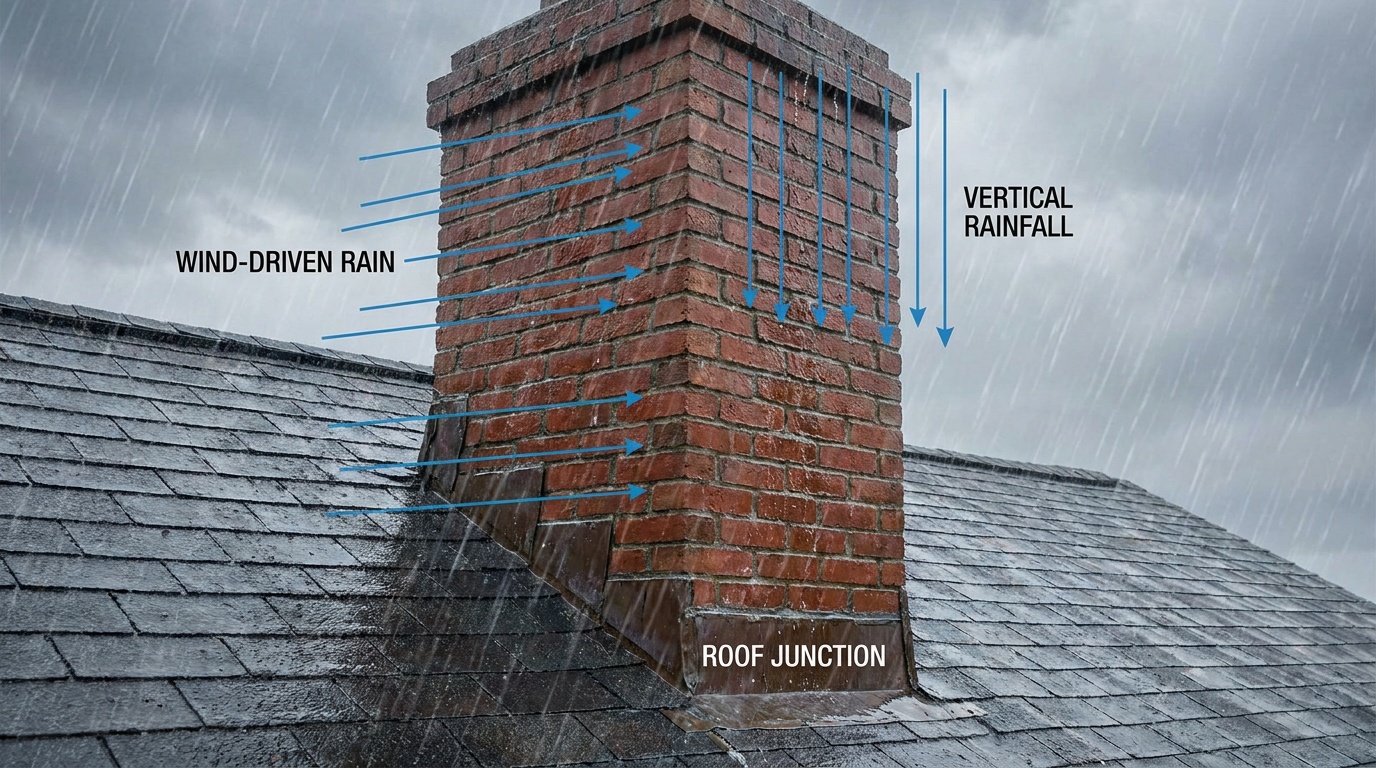


Here is a pattern almost every homeowner who calls us about a leak describes the same way: the ceiling near the fireplace stains after a storm, but a normal afternoon of rain does nothing at all. Weeks pass with no sign of a problem. Then one heavy night, the stain is back and slightly larger than before.
That pattern is not random, and it is not a mystery. A leak that only appears in heavy rain is almost always telling you the water is getting in at the roof junction rather than through the chimney itself — and in most cases the flashing is the reason.
The timing is diagnostic. Understanding why the leak waits for a storm is what tells you where to look.
In this guide, we'll explain:
- Why heavy rain behaves differently from light rain
- What chimney flashing actually is
- The five ways flashing fails
- What your leak's timing tells you
- What repairs cost
- What not to do
- How flashing gets assessed properly
Why Heavy Rain Is Different
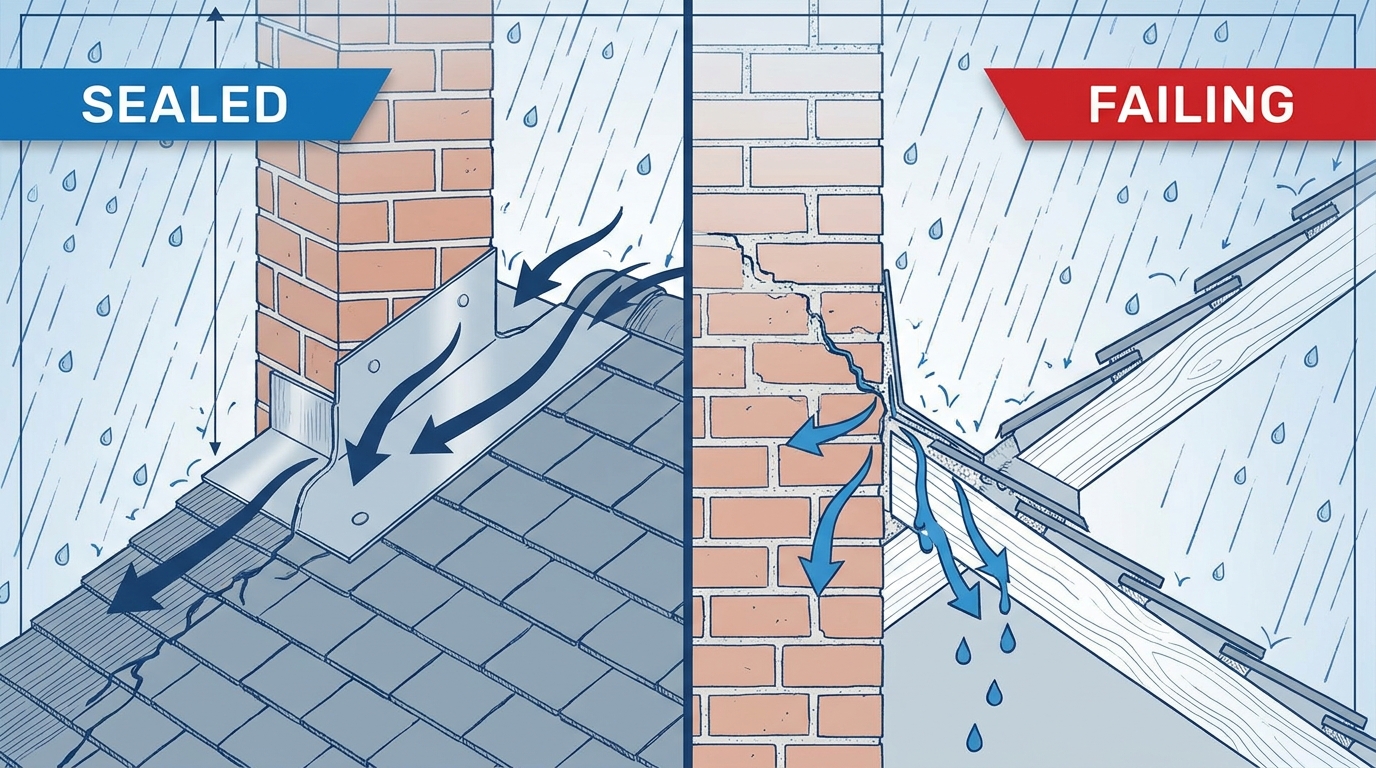
Light rain falls more or less straight down. It lands on the top of the chimney and on the roof surface, and the roof does exactly what it was designed to do: sheds it downhill.
Heavy rain behaves differently in two ways, and both matter.
It arrives sideways. Storms bring wind, and wind-driven rain hits the vertical face of the chimney rather than the top of it. Water then runs down the brick and reaches the junction where chimney meets roof — a place that vertical rainfall barely touches.
It arrives faster than the roof can drain. A roof sheds water at a certain rate. Exceed that rate and water backs up, pools briefly behind the chimney, and finds its way under shingle edges that a slower flow would have passed straight over.
Both effects converge on the same few square feet: the flashing. That is why the same chimney can be watertight through an entire mild season and fail on the first real storm.
What Chimney Flashing Actually Is
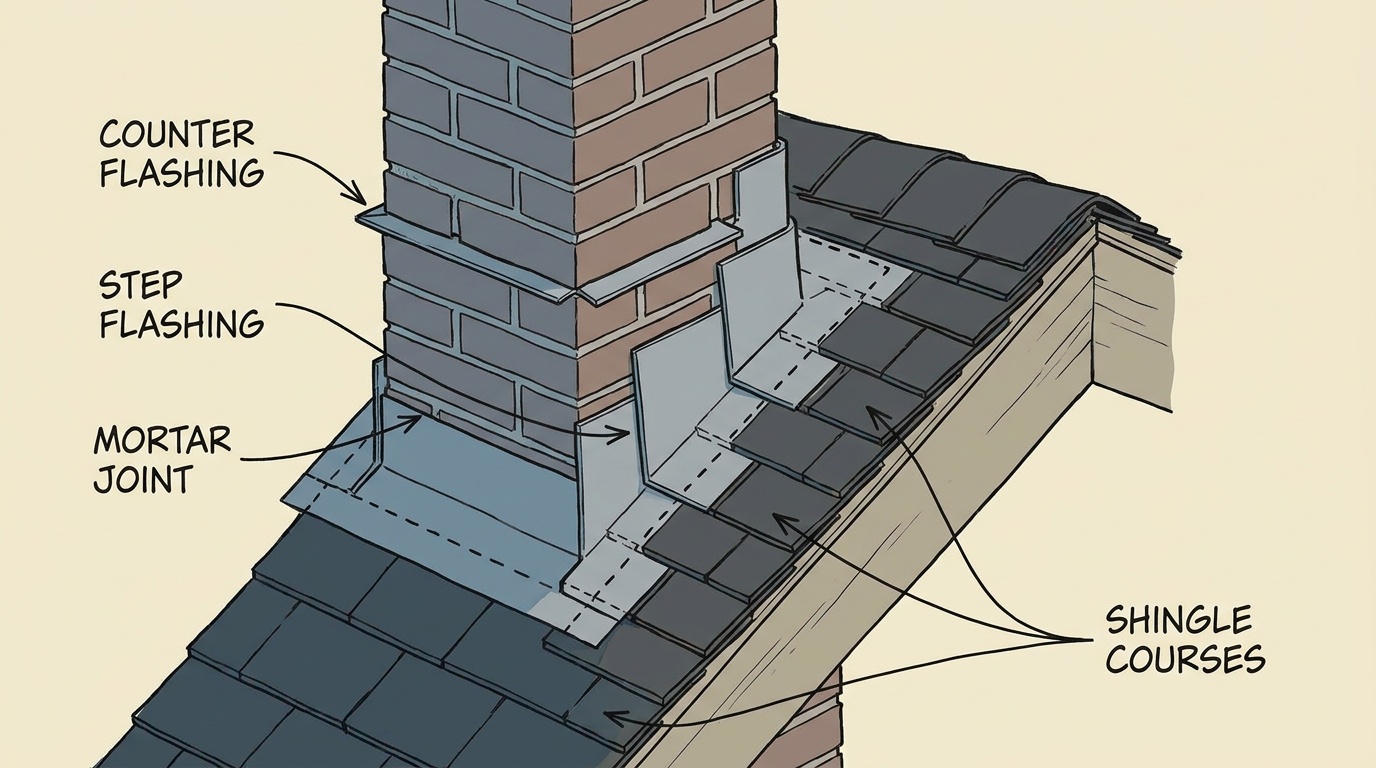
Flashing is the metal that seals the joint between two things that move independently: a rigid masonry chimney and a roof deck that expands, contracts, and settles. No sealant can bridge that joint permanently, which is why the solution is mechanical rather than chemical.
A correct installation has two separate layers, and most flashing failures come down to one of them being absent.
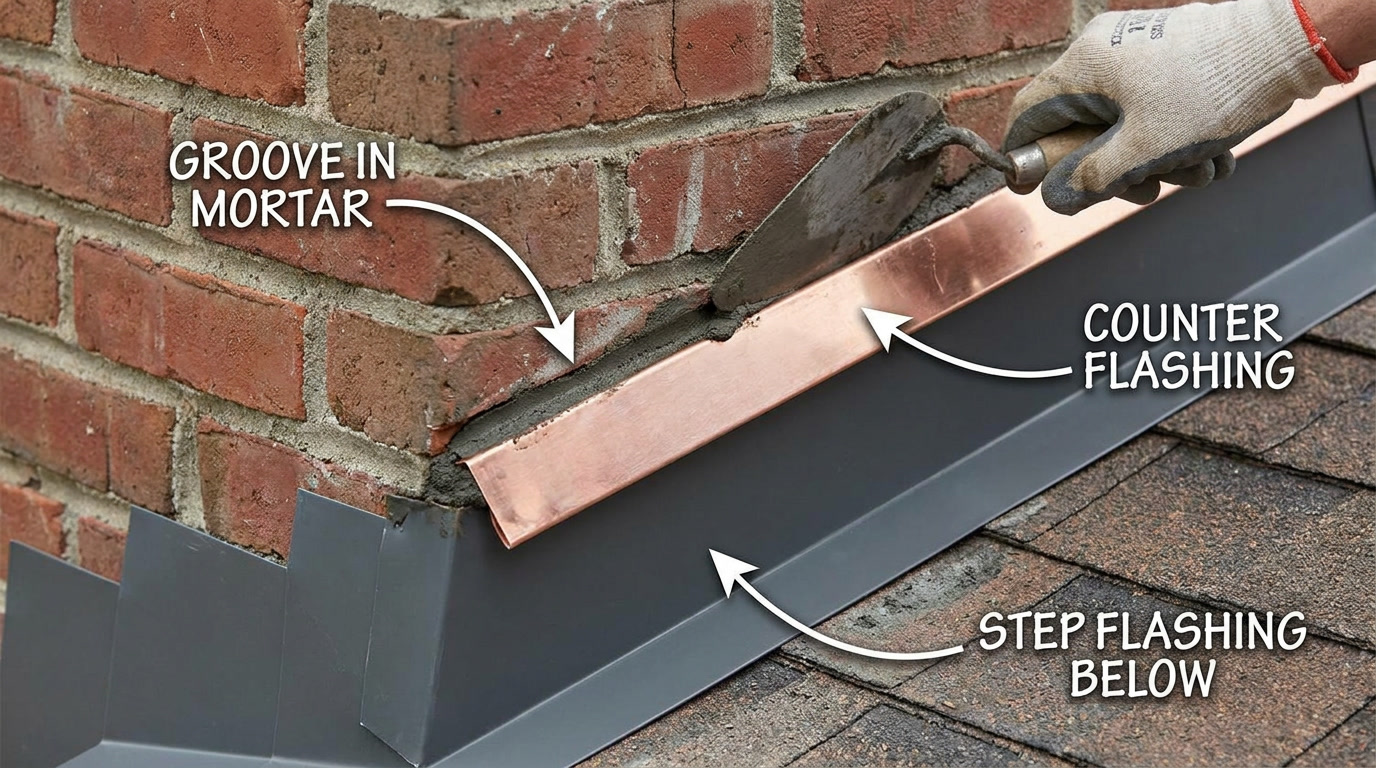
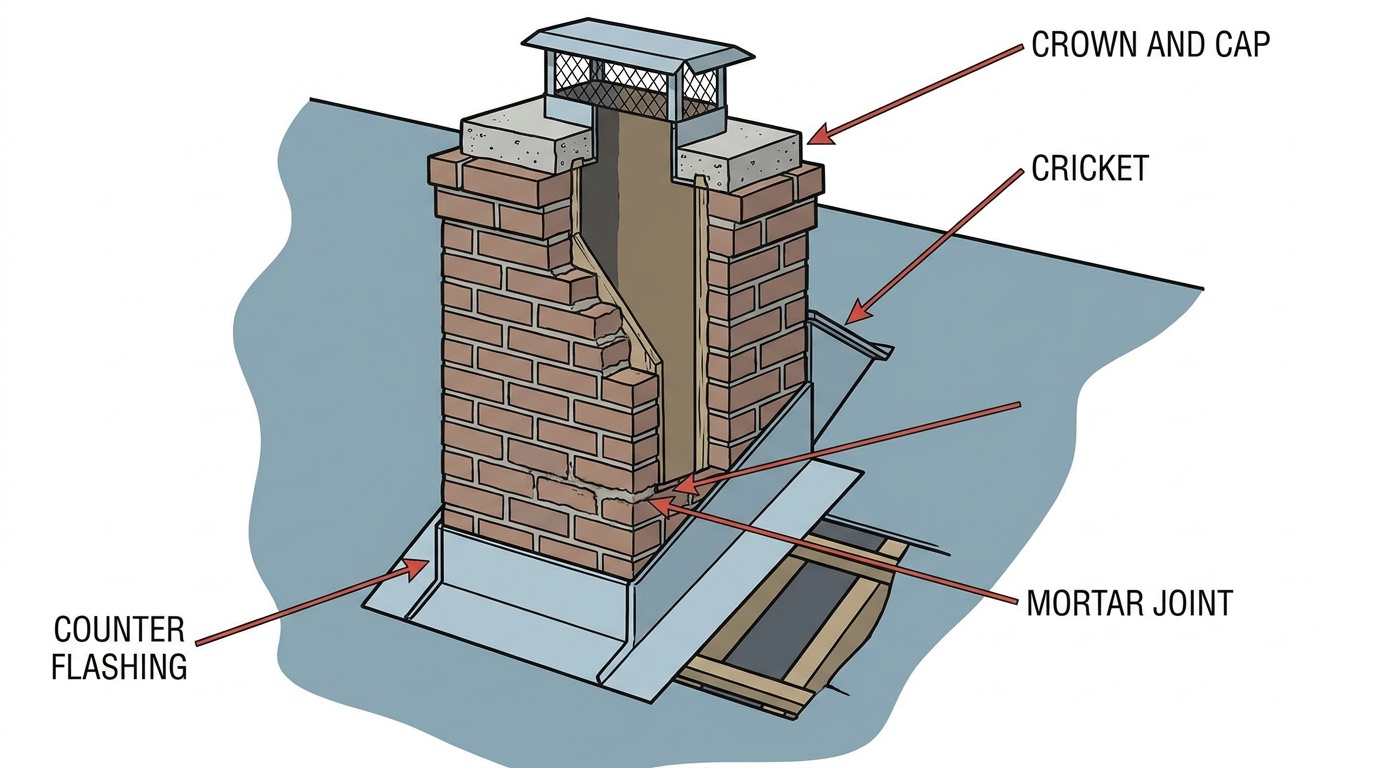
Step flashing is a series of L-shaped metal pieces woven into the shingle courses, one per course, running up each side of the chimney. Each piece laps the one below it so water is always directed onto the shingle surface rather than under it.
Counter flashing is the second layer, set into a groove cut in the mortar joint of the chimney and folded down over the top of the step flashing. Its job is to stop water running down the brick face from getting behind the step flashing.
Step flashing without counter flashing leaks. Counter flashing sealed with caulk instead of set into the mortar leaks as soon as the caulk fails. Both layers, correctly installed, will outlast several roofs.
The Five Ways Flashing Fails
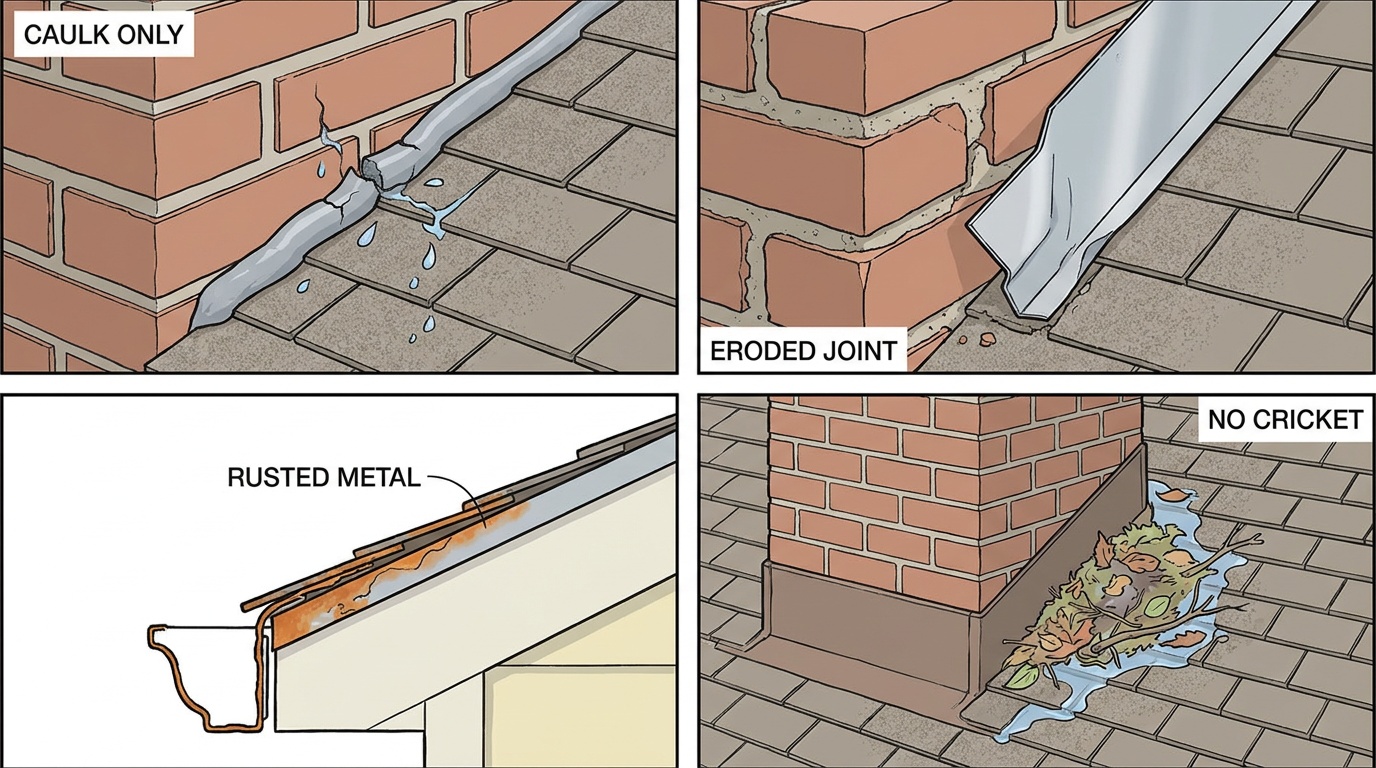
1. Caulk Instead of Counter Flashing
The most common failure we find, and the cheapest thing a previous contractor could have done. A bead of roofing sealant smeared along the joint looks like a repair on the day it is applied. It has a service life measured in a few seasons, because it is being asked to bridge a moving joint under UV exposure and freeze-thaw.
When it cracks, water goes straight behind the step flashing, and the leak appears exactly where it was before. Owners often describe this as the leak coming back — it never actually left.
2. Deteriorated Mortar at the Counter Flashing Joint
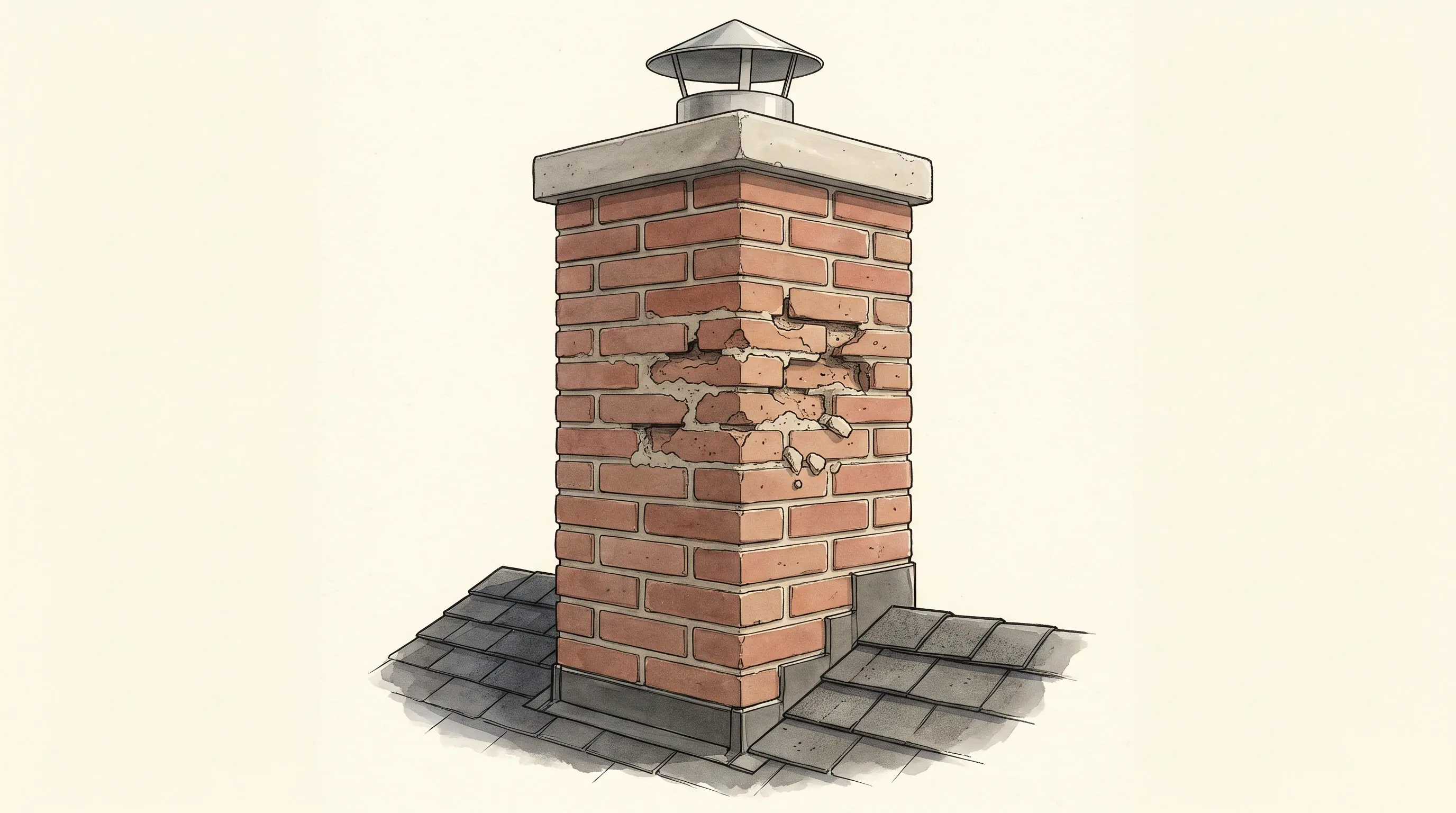
Counter flashing is only as sound as the mortar joint holding it. As that joint erodes, the metal loosens and a gap opens behind it. This one is insidious because the flashing itself is intact — nothing looks wrong from the ground, and the metal is not damaged. The seal simply is not sealing.
3. Rusted or Fatigued Metal
Galvanized flashing corrodes over time, particularly where water sits. Thermal cycling works on the metal as well, opening seams and lifting laps. Once there is a pinhole or a lifted edge, wind-driven rain will find it.
4. A Missing Cricket
On the uphill side of a chimney, water running down the roof hits the masonry and has to divide and go around. On a narrow chimney the flashing handles it. On a wide one it does not — water and debris collect in the low point behind the chimney and sit there, which is precisely the condition flashing is worst at resisting.
The solution is a cricket: a small peaked structure behind the chimney that splits water to either side before it can pool. Model code generally requires one on chimneys wider than about 30 inches measured across the slope, and the requirement is set out in the International Residential Code that most local codes are built on. Older homes and cost-cut installs often do not have one.
5. A Roof Replaced Without Redoing the Flashing
New shingles over old flashing is a false economy that shows up two winters later. The flashing is woven into the shingle courses, so replacing the roof without replacing the flashing means the new courses are laid around metal that was disturbed, bent, or reused. This is worth asking about directly if the roof has been done recently and the leak started afterwards.
What Your Leak's Timing Tells You
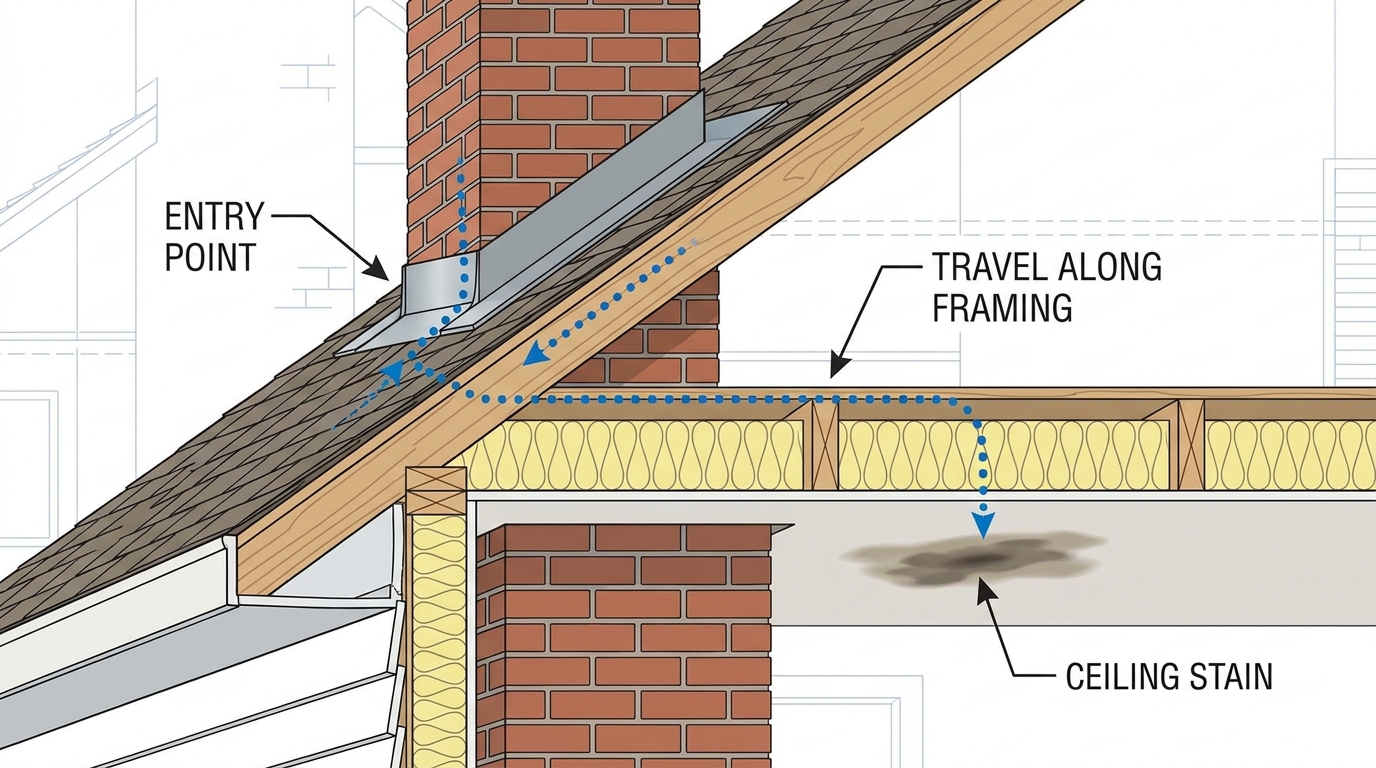
Before anyone gets on the roof, when the leak appears narrows the field considerably.
The last two are worth separating out properly. A chimney that stains a ceiling in dry, cold weather is not leaking in the usual sense — that is moisture forming inside the flue, and we cover it in our guide on how chimney leaks start from the inside out. Delayed staining after rain often points to the masonry itself absorbing water, which raises a different question we answer in whether a barely-used chimney still needs waterproofing.
If your answer is the first row, flashing is where a competent assessment starts.
What Flashing Repair Costs
Flashing work spans a wide range, because a localized repair and a full replacement are genuinely different jobs. Chimney flashing runs from $595 to $3,495 depending on the size of the chimney, the roof pitch, access, and whether a cricket has to be built.
Two things worth knowing before you compare quotes.
Flashing is a required line item on any chimney rebuild. If you are rebuilding a stack, new flashing is not optional — you cannot pour new masonry and re-seat old metal into it. A rebuild quote that omits it is incomplete.
Flashing is rarely the only thing wrong. Water that has been entering at the roof junction for several seasons has usually been working on the masonry too. If the crown is cracked, that is priced separately by the crown's dimensions — you can price crown repair or rebuild to see where yours would land. If the cap is missing or rusted through, a properly fitted cap is the cheapest protection on the entire chimney.
What Not to Do
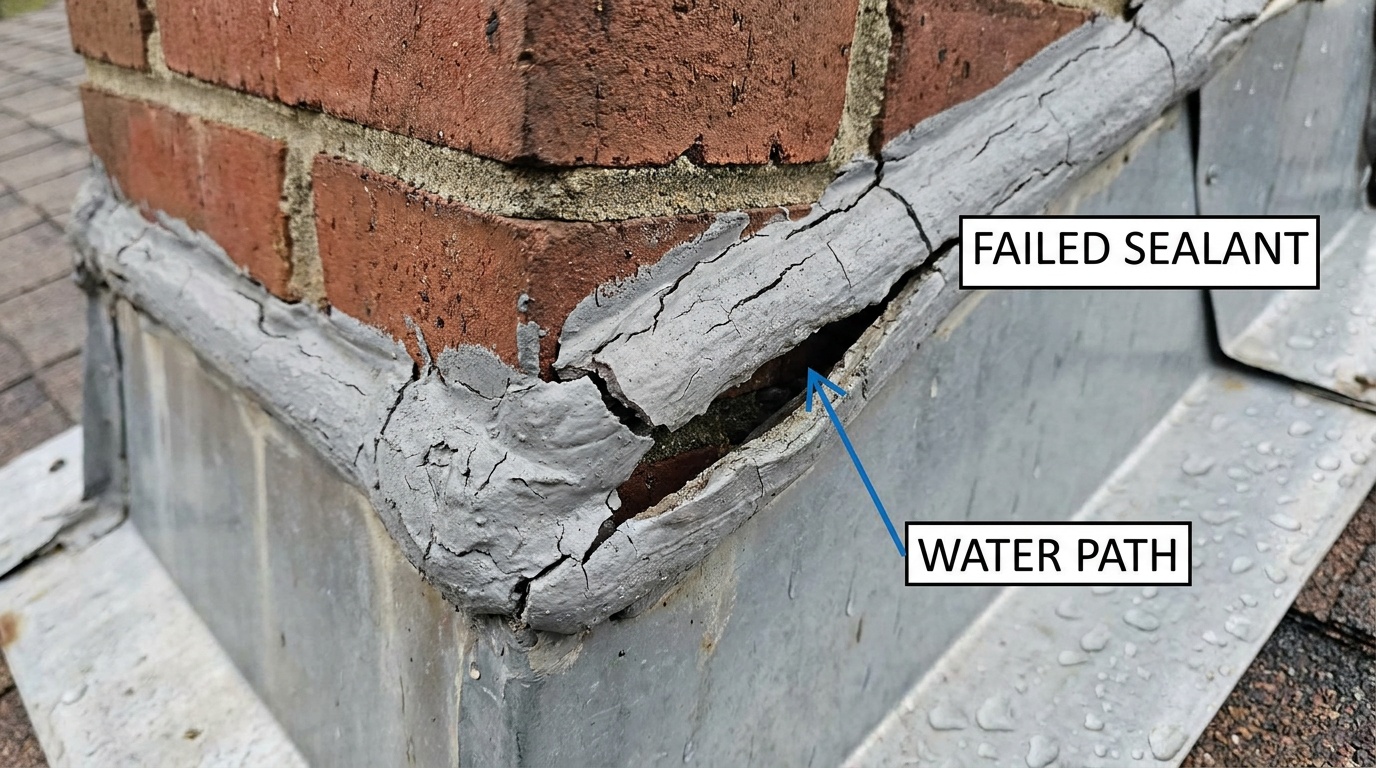
Do not seal it and hope. Roofing cement over a flashing joint is the repair that guarantees a return visit. It buys a season, hides the underlying condition, and makes the eventual proper repair harder because the old sealant has to come off first.
Do not waterproof over the problem. Masonry sealer is genuinely useful on porous brick, but it does nothing for a failed flashing joint — and applying a vapor-impermeable product to already-saturated masonry can trap moisture inside it. Sealing is for prevention on sound masonry, not for stopping an active leak.
Do not assume the stain is directly below the entry point. Water runs along framing before it drops. A stain two feet from the chimney breast is normal, and chasing the stain rather than the source is how people replace a ceiling twice.
Do not accept a diagnosis made from the driveway. Flashing condition cannot be judged from the ground. Anyone quoting a flashing repair without having been on the roof is guessing.
How Flashing Gets Assessed
A proper assessment answers four questions, and it needs someone on the roof to answer any of them.
Is counter flashing present, and is it set into the mortar? This alone resolves a large share of cases.
Is the mortar joint holding it sound? Intact metal in a failed joint leaks exactly like damaged metal does.
Is there a cricket, and does the chimney need one? Width across the slope decides it.
What else has the water already reached? Crown, cap, mortar joints, and the flue itself. Water that has been getting in for several seasons rarely leaves only one thing to fix, and a report that lists only the flashing is usually a report that only looked at the flashing.
If inspection identifies damage at the top of the stack, our guide to cracked chimney crowns explains the possible causes and when a surface treatment may be insufficient.
Flashing sits at the boundary between roofing and masonry, which is exactly why it gets neglected — roofers treat it as the mason's problem and masons treat it as the roofer's. We handle it as part of flashing and masonry repair, and quote whatever else the water has reached as separate line items so you can see what belongs to which job.
Final Thoughts
A chimney that only leaks in heavy rain is not an unpredictable chimney. It is a chimney with a specific, findable defect at the roof junction that mild weather does not reach.
The reason it matters to act on it is that the leak is not staying the same size. Every storm moves a little more water into the same path, and water that reaches masonry does its damage slowly and out of sight — opening mortar joints, saturating brick, and working toward the framing. The ceiling stain is the last thing to appear, not the first thing to happen.
If your leak follows the storms, get someone on the roof before the next one.
Frequently Asked Questions
Why does my chimney only leak in heavy rain?
Heavy rain is usually wind-driven, which pushes water against the vertical face of the chimney and down to the roof junction — a path light rain barely touches. Heavy rain also exceeds the rate the roof can drain, backing water up behind the chimney. Both converge on the flashing, which is why the leak appears in storms and not in ordinary rain.
What is chimney flashing?
Flashing is the metal that seals the joint between the chimney and the roof. A correct installation has two layers: step flashing woven into the shingle courses, and counter flashing set into a groove in the chimney's mortar joint and folded over the step flashing. Both layers are needed; either one alone will leak.
How much does chimney flashing repair cost?
Chimney flashing runs from $595 to $3,495 depending on chimney size, roof pitch, access, and whether a cricket needs to be built. A localized repair and a full replacement are different jobs, which is why the range is wide. Flashing is also a required line item on any chimney rebuild.
Can I just caulk chimney flashing?
It is not a repair. Roofing sealant over a flashing joint has a service life of a few seasons because it is bridging a moving joint under UV exposure and freeze-thaw. When it cracks, water returns to the same path, and the old sealant has to be removed before a proper repair can be made.
What is a chimney cricket and do I need one?
A cricket is a small peaked structure behind the chimney on the uphill side that splits water to either side before it can pool. Model code generally requires one on chimneys wider than about 30 inches measured across the roof slope. Many older homes do not have one, and its absence is a common cause of leaks that only show in heavy rain.
Does a new roof include new chimney flashing?
It should, but not every roofing quote includes it. Flashing is woven into the shingle courses, so laying new shingles around disturbed or reused flashing is a common source of leaks that begin shortly after a roof replacement. Worth asking about directly if your leak started after recent roof work.




RELATED ARTICLS
.jpg)
Schedule an Inspection Now
with expert chimney care.